## If Power Trips When the Office Is Full, That’s Not “Bad Luck”
We’ve all heard it: *"The power tripped? Must be bad luck."*
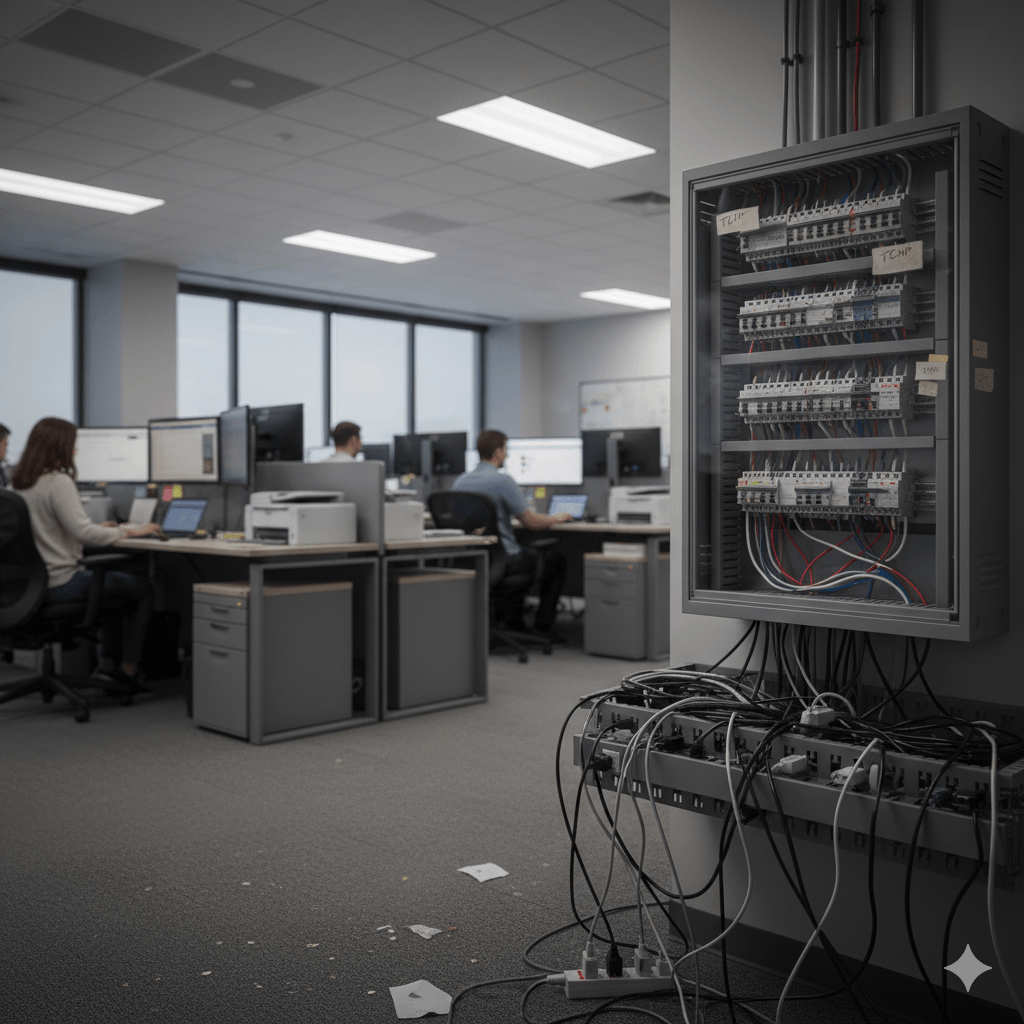
If Power Trips When the Office Is Full, That’s Not “Bad Luck”
We’ve all heard it:
"The power tripped? Must be bad luck."
In commercial buildings, that excuse doesn’t hold water. I’ve been on sites for over a decade, and here’s the reality: if your office power trips under normal full occupancy, it’s almost always an electrical planning issue — not luck.
Why Full Occupancy Reveals Hidden Problems
When an office is half-empty, the electrical system seems fine. A few lights, a handful of computers, minimal HVAC demand — everything works.
But once the office is full:
Every desk has a computer, monitor, and charger
Printers and copiers run continuously
HVAC and lighting run at peak
Servers and networking gear operate non-stop
The stress suddenly exposes circuits that were already overloaded, panels that are near capacity, or poorly coordinated systems.
If the system trips at that point, it’s a symptom of design shortcuts, not coincidence.
Common Causes of Trip Events
From years of site experience, these are the usual culprits behind trips during full occupancy:
Under-calculated load: The circuits were designed for less than the actual demand.
Poor circuit distribution: Too many high-draw devices on the same breaker.
No allowance for peak load: HVAC, IT, and lighting demand weren’t coordinated.
Shortcuts during installation: Wires too small, poor connections, or minimal spare capacity.
All of these are decisions that were made months or even years before anyone noticed the trip.
Why “It Passed Inspection” Isn’t Protection
Here’s the tricky part: inspections don’t prevent trips. They only confirm compliance.
A system can be neat, tidy, and compliant, yet still fail under real-world stress. That’s why experienced commercial electricians focus on how the building will operate, not just what looks good on paper.
A Commercial Electrician Sydney with commercial expertise will:
Assess full occupancy load scenarios
Plan circuits with room for peak usage
Coordinate with HVAC, IT, lighting, and fire systems
Build redundancy for critical systems
Ensure maintenance teams can isolate faults without shutting everything down
The Real Cost of Ignoring This
Power trips aren’t just annoying. They cost businesses:
Lost productivity for employees
Disrupted operations
Repeated call-outs and emergency fixes
Reduced lifespan for equipment
Frustrated tenants or staff
What seems like a minor “trip” can snowball into months of operational headaches.
How to Protect Your Office
Ask potential electricians:
“How will you account for full occupancy load?”
“Do we have enough spare capacity for peak demand?”
“Are critical systems isolated?”
“How will maintenance handle faults without downtime?”
If they shrug, promise to “fix it later,” or only talk about aesthetics, consider it a red flag.
The Takeaway
Power tripping when the office is full is not bad luck.
It’s the result of earlier electrical decisions — often invisible but very real. The good news is: a properly planned and installed commercial system can handle full occupancy with zero disruption.
In commercial electrical work, prevention is always smarter than reaction.